
How to (Not) Deal
Physical, emotional, and existential issues got you down? Ask your doctor if AcrossTheBoardAvoidance™ could be right for you.
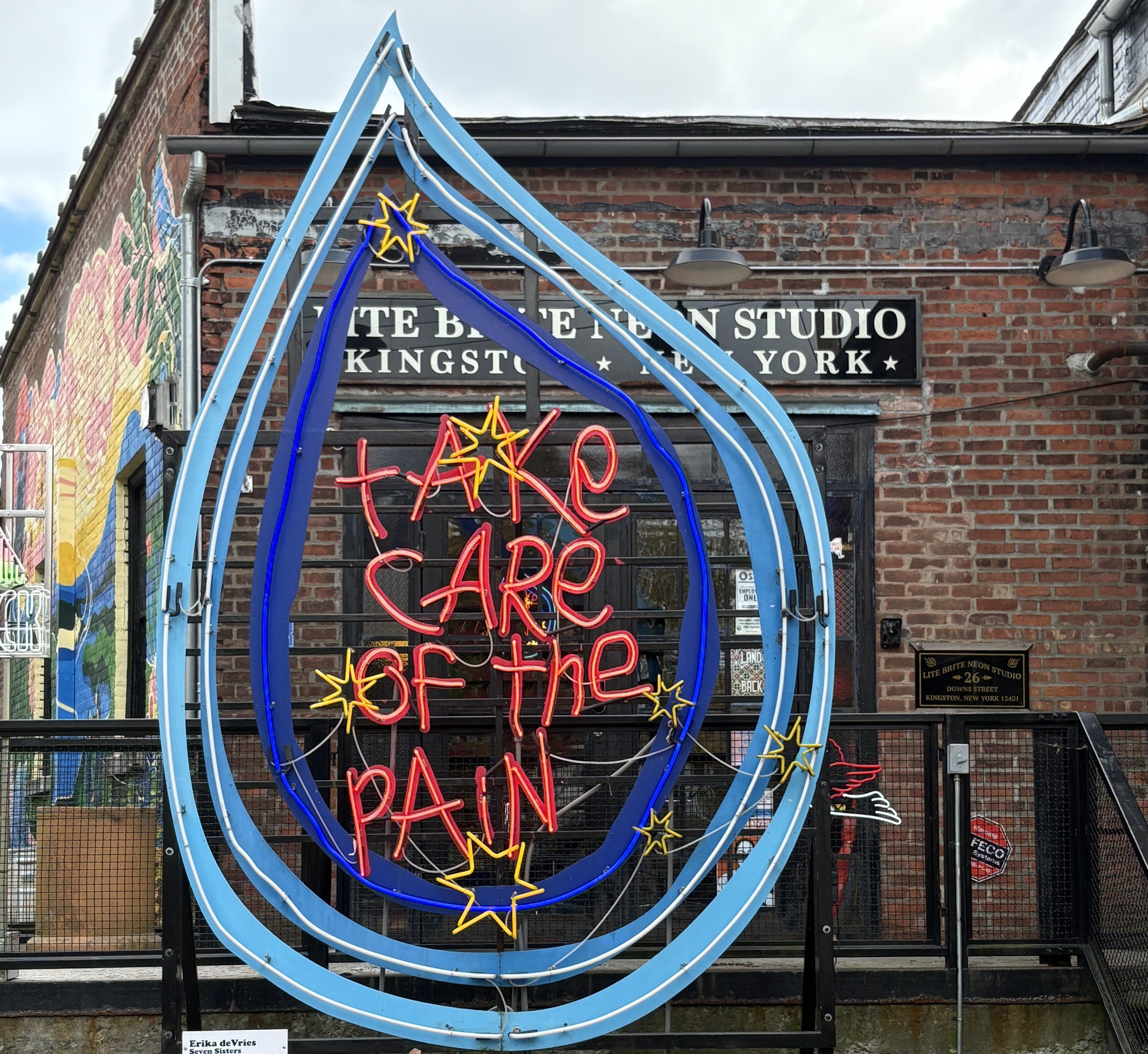
In these horrid times are you, like me, enduring all sorts of psychic and corporeal pain? Have you similarly lost faith in most or all the various (often contradictory) remedies on offer? (Does your expensive yet useless American health insurance simply not cover most them?)
Perhaps you might benefit from my patented approach, AcrossTheBoardAvoidance™. Here’s how I’m using it to address my assorted sources of misery.
Overheard in Kingston, NY: “MY ENTIRE SKELETON HURTS”
Okay, it was me—I’m the one who said it. Says it. At least twice a day poor Brian has to listen to me make that dramatic declaration. But it’s true. I have arthritis throughout my body. It’s worst in my hips, knees, neck, and shoulders.
There was a significant period during which Brian would make thoughtful suggestions like, “What if you tried hanging down upside-down on an inversion table?” (I have no idea where he thinks I might locate an inversion table.) Now he just smiles lovingly, resignedly, until I’m done kvetching and move onto another topic, like my overarching malaise, a common effect of living in These Times.
My orthopedist wants me to try Platelet Rich Plasma injections for my largest pain center, my bum hip. But those are considered by the medical establishment to be experimental, and therefore the $1200-$1500 a pop is uncovered by insurance. When I polled friends (and “friends”) about this treatment on Facebook, half of those who tried it raved, the other half said it was a painful (big needle, no anesthesia—see: ineligible for insurance) waste of money and time.
He also sent me for physical therapy, which made things worse. Oh, how many people I’ve had to listen to insisting I need to give PT another try! Oh, how much energy it takes for me to explain that since then, we’ve learned I have gluteal tendinopathy—a degenerative fraying of the hip tendon, for which PT is apparently contraindicated.
What is advised? Because gluteal tendinopathy appears to be menopause-related, hormone therapy is recommended. Except…not for me. Nope, too much breast cancer (and other reproductive cancers) in my family.
Two years ago I received an epidural injection of cortisone in my sacroiliac joint, which gave me nine blessed months of partial relief from my pain. Then my mom fell and when I picked her up, I threw out my back and hip, causing new spinal damage, and undoing all that relief.
Now Fidelis, my insurance company, has decided to belatedly deny coverage for the shot, and my orthopedist and I are both having to fight them. If we fail, that’s $10K I don’t have. So I guess I’m not going to be winning another one of those magical steroid injections in the American health insurance sweepstakes.
And I guess it should be no surprise that in 2026 the Optum medical network, which includes most of my doctors, will no longer be accepting Fidelis insurance (the cheap—er, “cheap”—option on the New York State Marketplace). Now I have to find a new provider. For a lot more money. I hope they cover at least a few basic medical necessities!
In the meantime, I’m basically striving, hour-to-hour, to ignore my body-wide agony, doing little more than occasionally popping a Meloxicam, an anti-inflammatory drug that is less hard on the stomach than Advil, which I can’t tolerate.
It’s Dark Out There…and In Here 🧠
Seasonal-affective depression showed up right on time this year, the day we turned the clocks back. Actually, I’d felt it creeping in for a week or two before. I’m buckling up for a solid five months of this, until we switch back to Daylight Savings Time. (Although I did get quite an emotional boost from today’s election results.)
I go through the sunnier half of each year with a baseline level of depression I’ve learned to tolerate. The darker half of the year is always a bigger emotional challenge. Someone gave me a special lamp for dealing with Seasonal Affective Disorder. I’ve tried it to negligible effect. Maybe I should give it more time, but that would cut into my YouTube-karaoke-at-my-desk time, which actually seems to help.
My depression was particularly acute a few winters ago, when my freaking journal was subpoenaed in a #metoo-related case (like the bridge-and-tunnel New York literary world Zelig I occasionally show up as, I’m the reason a certain person had to settle his defamation case)—and, simultaneously, a forensic accountant from the United States Government was scrutinizing every transaction recorded in my checking account.
That year I tried to find a new therapist. I’ve been something of a psychotherapeutic orphan since my last one closed her practice. In my search, I found it wild how many sketchy modalities shrinks were now tacking on to their credentials. I gave a therapist who uses Somatic Experiencing a try, and it did not go well.
It made me nostalgic for regular-degular talk therapy like you’d get in the 90s and aughts. For those unfamiliar with such halcyon days, for a $25 copay per session, courtesy of your $200/month Oxford plan, someone would listen to you spin out in the same ways, week after week, and then point out that you were spinning out in the same ways, week after week, and you’d feel slightly better and more self-aware for the remaining six days until your next appointment.
Nobody was interrupting your ugly cry to say shit like, “Oh, no, we don’t talk about our feelings anymore. Now, we do this instead: tap your shoulders with your fingertips. Feel Mother Earth underneath you. Imagine that she is reaching up and supporting you. Can you feel her? You’re supported!” All this can be yours for $200 per 50-minute session.
That experience put a serious dent in my faith in the talking cure. Still, recently I thought I might try to find a therapist. I was particularly interested in someone who treats patients through the lens of neurodivergence. As with just about all my various conditions, I’ve done virtually nothing to delve into the level one autism I was diagnosed with last year. I mean, I don’t really feel like doing anything about it? Maybe I never will? It’s kind of been satisfying enough just to have that suspicion about myself confirmed. But I wondered whether trying therapy from that angle might help me in some new and different way—while also helping me feel like less of a lazy bum for not having delved into my diagnosis.
Scrolling Psychology Today’s listings, I learned most of the therapists in my area who do that work treat only neurodivergent children. I reached out to the sole practitioner who seems to work with adults, but it took her six weeks to reply, and when she did, she informed me she’s not taking new patients. She referred me to someone who is not trained to address neurodivergence, who I know tangentially, socially (a hazard of seeking out shrinks in a city with a population of just 24K).
In recent weeks my faith in the whole psychology enterprise has been further shaken, thanks to some articles blowing the lids off multiple kinds of trauma therapies. But the backlash to one of those articles, calling it a sensationalized hit piece, has shattered my already tenuous faith in legacy magazine journalism.
Hey, in these dystopian times, what’s one less thing to believe in? And one more pressing problem to do not one fucking thing about?
Can Somebody Please Pass the Workahol?
It has been suggested by some that I might have descended into the depths of workaholism, juggling, as I do, the editing, publishing, and publicizing of two magazines, posting eight to ten times a week, while also trying to extend each magazine’s reach beyond this platform with things like live events, a book proposal, and a possible podcast.
Maybe this is the workahol talking, but hear me out: You need work to live. Also, I’ve got all my eggs in this digital magazine basket, and I need to keep this top spinning for as long as I can because I have absolutely no idea what I’ll do next if this whole gambit gets enshittified.
Also? Work makes me feel good—and accomplished, and proud, goddammit. It distracts me from the autocratic hell we’re living through. So what if I spend most of my days strung out on the dopamine derived from next-right-thing-ing it from dawn to dusk? Whatever gets you through the (dark) night (of the soul), amirite?
People also like what I do. Which unfortunately brings up my addiction to people-pleasing, about which I’m doing, you guessed it, nothing.
“And I said, ‘Nothing; I’m feeling nothing’”
In conclusion, what am I doing about my pervasive arthritis, fragile emotional state, Level 1 autism, and workaholism? Nada. Zilch. Zip.
How are you all dealing with your assorted kinds of pain? Have you considered doing not one fucking thing? I’m not sure I can recommend it, but I’m also not sure I can recommend anything else.
Where to find my other work:
Every semester when I played the documentary Rosie the Riveter for my US history students, I teared up at the section where one of the women who was interviewed described working during the dark days when her husband was a soldier, and she hadn't heard from him for some time, and she said the words, "Work makes life sweet." So often when I feel like I, all unsuspecting, have discovered that at age 75 I am a bit of a workaholic (being retired and not having to do the writing and publishing to keep roof over head) and that I "should" cut back, and I remember that woman's words, and smile.
Your work is awesome. If it makes you feel good, even better. So many people wish they had meaningful work. Rooting for your publications and continued success!